That's a good thing. Now it's about making sure it's working for everyone on the team — the right tools, in the right places, with a strategy that moves at the same pace your people do.

.png)


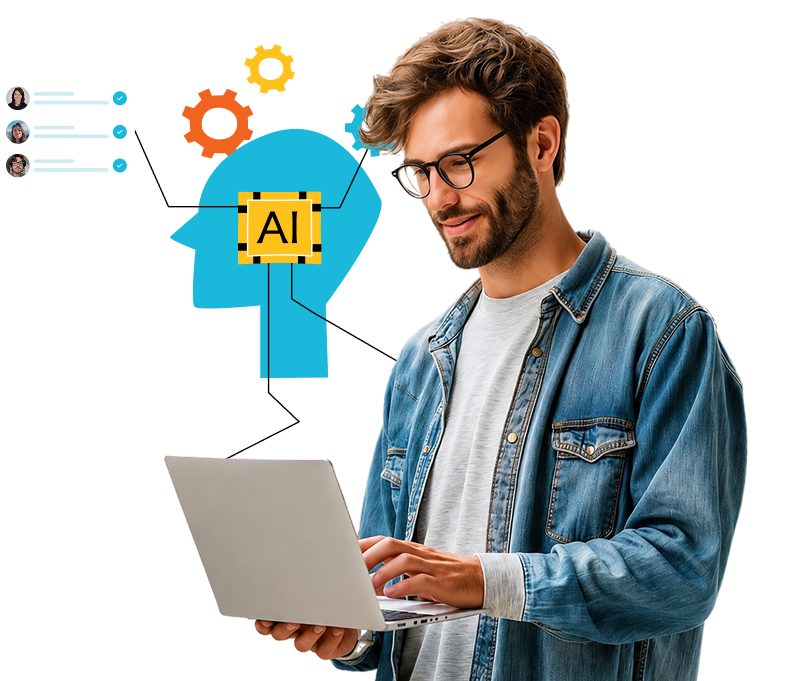
AI should help people move faster, think clearer, and spend more time on the work that actually needs them — without asking everyone to become an AI expert overnight. The cape should make the work easier, not add another layer of confusion.
.png)
.png)
A practical AI plan starts by understanding what is already happening, where AI can remove friction, what data and workflows need protection, what costs are emerging, and which tools actually fit the way your team works.

Most teams are further along than they think. The first step is getting a clear picture of the tools, data, workflows, costs, and integrations already in play.
.png)
.png)

With great power comes great responsibility." A caped hero said it first — and it applies here too. AI gives your team real capability, which means making sure it lands in the right places, for the right roles, matched to work that actually needs it.


Each team uses AI differently. Together, we look at how people actually spend their time, where work slows down, which tools are already involved, and where AI or automation can help without creating unnecessary risk.

Some work does not need to wait on a person every time. When the right guardrails are in place, reports can generate, data can move, approvals can route, and systems can update without someone chasing every step.

This is where the cape comes in. AI should help people draft faster, analyze better, and make clearer decisions — while keeping human judgement where it belongs.
The right mix may include AI-enabled SaaS tools, LLM platforms, private workspaces, or tools already embedded in the systems your teams use every day. Some tools are fine in the cloud. Some workflows need tighter control. And some knowledge should stay inside your own environment.
Every AI choice should earn its keep: what it costs now, what it may cost later, what it touches, and whether it gives people more capability without making the environment harder to manage.
.png)
.png)

This is the point of the whole exercise: your people get more capacity, repetitive work gets handled, and the business has a clearer view of where AI belongs.
.png)

More time for work that actually needs people — better decisions, stronger client relationships, work that moves the business forward.
With fewer handoffs, less chasing, and better outputs — not because people worked harder, but because the work got smarter.
Into AI use, cost, risk, and data exposure — so every decision about AI is made with a clear picture of what it actually involves.
"Your team gets time back. The business runs leaner. And you have a much clearer picture of what AI is doing, what it costs, and where it belongs."
AI strategy works best when it is connected to the people, systems, security, support, and day-to-day technology decisions that already keep the business running. That is where DeepNet is used to working.
Practical guidance without outside investor pressure.
The goal is a healthier, easier-to-manage technology environment, not unnecessary dependency.
A team with a long-term stake in client outcomes.
A values-led approach to technology decisions.


Together, we'll build an AI strategy that fits how your team actually works, practical, protected, and easy to understand.
One of our AI leads will be in touch to arrange a time.