


.webp)

Prefer the whole thing? Watch the full session on YouTube — 7:10.
There are three kinds of AI a business can buy. They increase in power, cost and effort in that order — and most organizations start at the wrong end of it.
That's the expensive mistake, and it's an easy one to make. The most ambitious option is the one that sounds like strategy, so it's the one that gets proposed. Below is the sorting I use, the order I'd take them in, and the question that belongs to each rung.
The three flavors, briefly
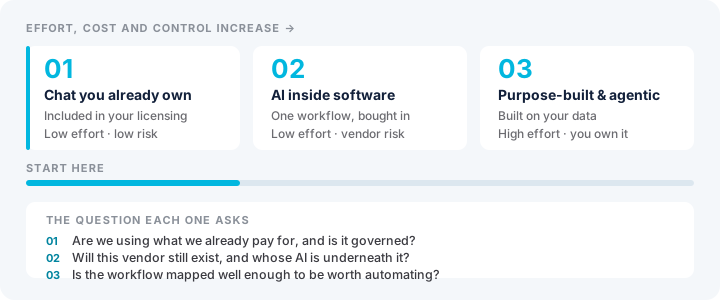
One: the chat you already own. Claude, Gemini, ChatGPT, Copilot. Self-serve, conversational. If you're on Microsoft or Google, a version is already inside the licensing you pay for today.
Two: AI inside software you buy. Built to produce one workflow outcome — sales development, recruiting screens, meeting notes, support triage. Cheap, because the vendor spreads cost across thousands of customers. Inflexible, for the same reason.
Three: purpose-built and agentic. Built on your data, your workflows. Highest effort, and the only one you end up owning outright.
We decided AI is infrastructure, not a product line
We've managed critical technology infrastructure since 1999 — twenty-seven years. Servers, cloud services, backup, recovery, access control, documentation. When AI arrived the question was whether it was a new category or an extension of what we already do.
It's an extension. AI lands on the same risk domains, and architecturally it behaves like a complex application that happens to request unusually broad access. Uptime, security, recoverability, auditability — we already work from that list.
The consequence is that we end up governing something our clients are enthusiastic about. That's a less comfortable place to stand than selling it to them.
Rung one is already switched on
Most organizations have a governed AI assistant sitting inside licensing they already pay for. Copilot Chat is included in most Microsoft 365 licensing. Gemini comes with paid Workspace plans. Neither is the top tier — Copilot inside Word and Excel needs the paid add-on — but both are real, both are governed by an agreement you already signed, and both are probably switched on now.
This isn't an argument for stopping there. It's an argument for not skipping it. Getting a whole organization genuinely fluent on rung one is what makes rung three achievable later — the teams that struggle with custom automation are usually the ones who never built the habit.
It matters early for a second reason, because the alternative to a governed tool isn't no AI. LayerX found in 2025 that 71.6% of employees keep using AI tools even under an outright ban. A prohibition doesn't remove the tool from your business; it removes your visibility of it. Closing that gap with something you already own is the cheapest risk reduction available.
This isn't a new posture. We take no markup on any hardware we procure. Same logic: if advice is only good when we make money on it, it isn't advice.
Where an organization decides to standardize on one platform rather than whatever came bundled, that's a piece of work in itself — configuring it around the boundaries you already have, and writing the decisions down. Claude for Teams is one route we deliver that.
We evaluate rung two rather than pushing it
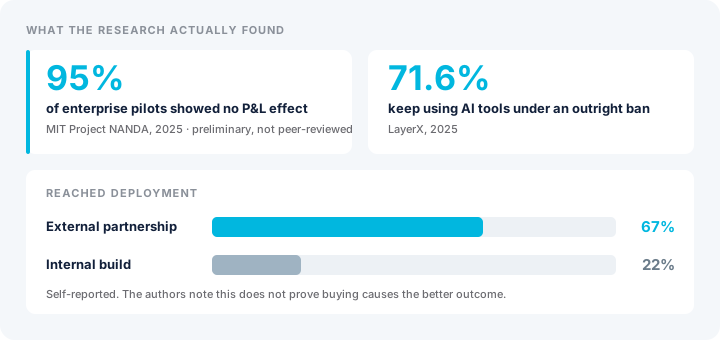
MIT's Project NANDA published research in 2025 finding that roughly 95% of enterprise generative-AI pilots produced no measurable effect on profit and loss — only about one in twenty delivered real value. It's preliminary work, not peer-reviewed, so I'd treat the precise figure as indicative. The direction matches what we see.
What it found about why is the useful part. The failures weren't about model quality. They were about integration — tools dropped into a workflow they never learned.
There's a second risk specific to this rung and harder to quantify: vendor survival. AI startup failure rates are high, and I've quoted around ninety percent in the past. I'd now say that honestly — that's my estimate, not a citation. The published research on AI-specific startup failure is thinner than the confidence with which the number gets repeated, including by me.
The underlying point stands regardless. If we push a vendor into your environment, you standardize a workflow on it, and the company folds, the disruption is yours and the mistake was ours. So our role is evaluation, not resale. Sometimes that means saying no to something a client is excited about — worse for the relationship this quarter, better over five years.
Four questions, one per flavor
- Flavor one — Are we using what we already pay for, and is it governed?
- Flavor two — Will this vendor still exist, and whose AI is underneath it?
- Flavor three — Is the workflow mapped well enough to be worth automating?
- All of them — Who approves access: an administrator, or whoever clicks accept?
Rung three is where you're heading, not where you start
Purpose-built and agentic is the one worth reaching. It's built on your data and your workflows, and it's the only rung where you own the thing outright. Nothing above is an argument against it.
It's also the hardest to finish, and that's the part that gets underestimated. The same MIT research found external vendor partnerships reached deployment about 67% of the time against roughly 22% for internal builds. The authors were careful — self-reported, and no proof that buying causes the better outcome — but the gap is large enough to plan around.
Most of the effort isn't technical either. It's mapping what the workflow actually is, which takes longer than anyone expects because the workflow usually changes once automation is in it. That's the case for climbing rather than jumping: an organization fluent on rung one already knows what its workflows look like. The full session walks all three rungs slide by slide, with the detail this summary leaves out.
Why our advice isn't shaped by a quota
We're privately held. No outside investors, no private equity. We're one of only a handful of certified B Corp MSPs in North America, certified since 2021.
That structure is why the incentives line up. Nobody is asking me to hit a resale target on AI this quarter, so the sequence we recommend is the one we'd follow ourselves. Client satisfaction sits at ninety-nine percent, and I'd rather protect that than book margin on a tool I don't believe will last.
Three rungs. Four questions. Climb all of them — just not out of order.
That's how I see it.
Watch the full session
There's a shorter version of this on LinkedIn. If you disagree with any of it, that's the better place to say so.